From Switzerland to Northern Germany and back again to Belgium
- 22. Nov. 2025
- 2 Min. Lesezeit
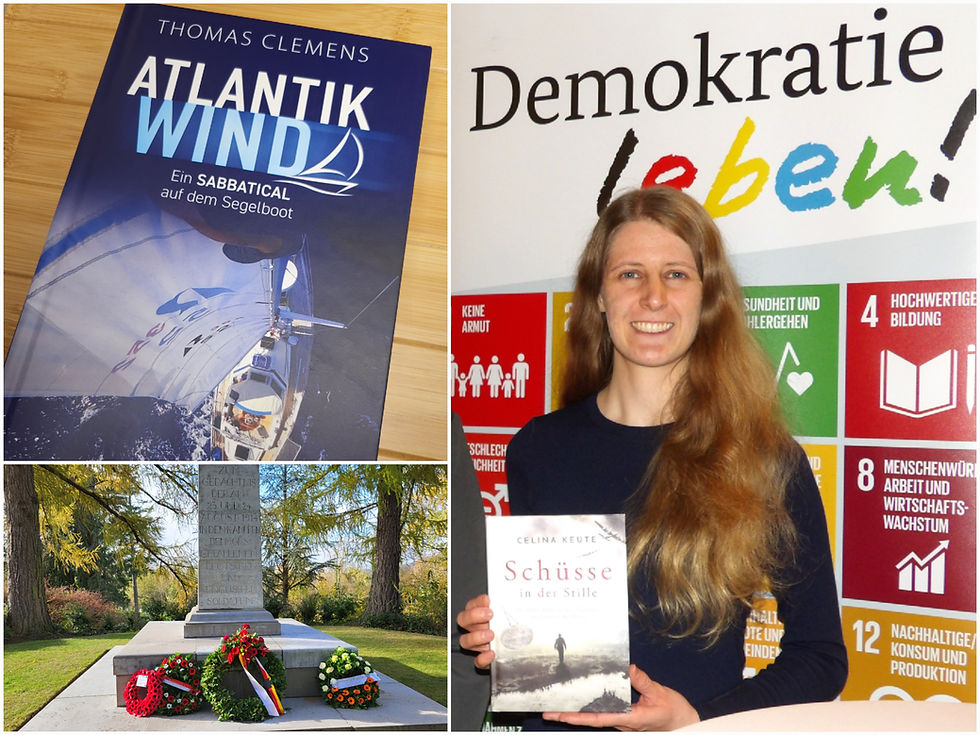
My next reading took place in an education centre in Gevelsberg (North Rhine-Westphalia) as part of the support programme “Demokratie leben” (“Live democracy”). There, I met Thomas Clemens, the author of the book “Atlantikwind” which I had copyedited. In his travel report, he writes about his sabbatical during which he crossed the Atlantic Ocean with his sailing yacht Petoya Too. It is an inspiring book which describes how everyone can make such a journey reality, and shows that there are humanity, trust and cooperation everywhere, even in the most unexpected situations.
Afterwards, I drove to Northern Germany where I gave a reading in Otterndorf, located in the district of Cuxhaven at the North Sea coast. A woman who attended the reading told me afterwards that one word she took away from the event was “perspective change”. This is something I always mention in my readings, because I assume that – besides knowledge – it is a key aspect contributing to understanding and reconciliation. Furthermore, she pointed out that my entire life is a constant change of perspective because I live and work location-independently, travel to different countries and speak with a lot of people about war, remembrance, language and culture. This makes me constantly see the world from different points of view. She also mentioned that remembrance work does not end with the war generation but continues to be important, and that her grandparents’ experiences still influence her today.
From the North Sea, I drove back to Belgium and spent the Armistice Day – the 11. November remembering the end of the First World War – in Mons. There I attended a commemoration event on St. Symphorien Military Cemetery to which also children contributed with speeches and songs. This place is special because it is a mixed cemetery for both German and Commonwealth soldiers. “Former enemies are buried here side by side”, one of the speakers said during the event, and it is striking that British wreaths are placed in front of German graves and the other way round. This is a true example of reconciliation and remembering both sides together.
Meanwhile I stay for around two weeks in East Belgium to visit three schools in the German-speaking Community where I give seven book readings and one writing workshop.