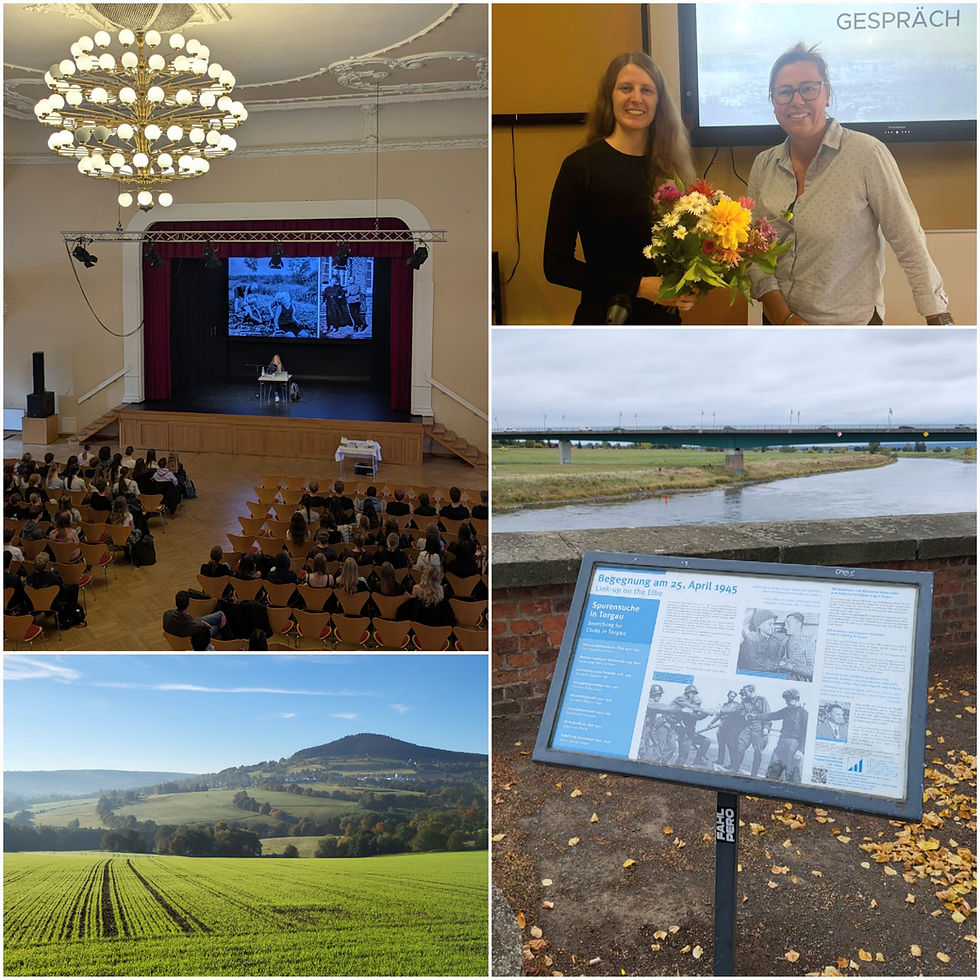
A reading tour through Saxony: 12 days with 11 readings in 10 cities
Recently, I took part in the programme “JuLian – Jugendliteratur anders” (“young adult literature differently”) organised by the State Association of Saxony in the German Library Association. Libraries could invite school classes to an event to encourage young people to read. Every day, I gave a reading in the morning and travelled on to the next place.
Although I had been to Saxony before, it gave me a new perspective on the state by travelling to so many different regions. Thereby I realised how diverse it is in its landscapes, from the Vogtland via the Ore Mountains to the Elbe Sandstone Mountains. I discovered the cultural and historical influences: Several German place names have an Old Slavic or Old Sorbian etymology, also the proximity to Bohemia in the Czech Republic is striking. Renaissance and baroque architecture stands alongside Plattenbau, the concrete apartment buildings typical for states in the former Eastern Bloc.
Generally, the time of former East Germany is still noticeable. In Torgau, where the American and the Soviet troops met at the Elbe river in 1945, I came across monumental Soviet-built memorials honouring the Red Army and the Soviet peoples. After the NS dictatorship ended in 1945, a second dictatorship followed until 1989. Therefore, contemporary witnesses often speak in schools about their experiences in the East German state, about the SED regime, the Stasi surveillance and the Berlin Wall.
As I was in Saxony on the 3rd of October, the German Unity Day marking its 36th anniversary, I also spoke with the people about the unity and how they evaluate it. Many told me that the East and the West have approached each other well in their opinion, but they still see differences, for example in the mentality of the people. An interview partner mentioned that some people still mentally distinguish between East and West Germans. Also I learned that there is a strong East German identity among young people nowadays, even though they did not experience the country’s division.
I enjoyed speaking to so many young people during the tour and hearing what concerns them. In Coswig, a neighbour town of Dresden, six or seven students told me how their families had experienced the bombing and the firestorm. In Leipzig, a pupil came to me after the reading and asked me to evaluate whether I think a war might come. He was afraid of that potential danger.
In Delitzsch, I encountered a successful method to increase the students’ attention. They had to put their smartphones in a “smartphone garage” on the wall with numbered pockets, looking like an Advent calendar. Although students are generally attentive during my readings, I realised that putting their phones away had a noticeable effect. Maybe I will introduce this system at other readings, too.
It was a very interesting tour with insights into Saxony’s history, culture and society, connecting the past with the present.